Translate

Showing posts with label Health Care. Show all posts

Sep 9, 2016

Forty Percent of the Population Has Nutritional Deficiencies

Nutritional deficiencies have become a major issue because our soils are depleted in minerals required for nutritionally dense foods. Based on the National Health and Nutrition Examination Survey more than 40 percent of adults have low levels of vitamin A, C, D and E, calcium and magnesium for their age and gender.  Vitamin deficiencies are common in teenagers 14-18 year old, and younger children are often low in calcium, vitamin D and E.  Most people do not get enough calcium in their diets which can be a main cause of osteoporosis. (www.ewg.org/research/how-much-is-too-much/appendix-b-vitamin-and-mineral-deficiencies-us) In addition, many people are on pharmaceutical medications for health issues that may be nutritional deficiencies.  Nutritional deficiencies are also known side effects for many pharmaceuticals. This is why everyone should take a good multiple vitamin.

Some of the main nutritional deficiencies include the following:

  • Vitamin B6 and folate especially if the person has been on birth control pills.  Many people with anxiety and/or depression can be deficient in B6 and folate.  And they may have methylation issues in which they do not absorb normal B6 or folate.  Individuals with high homocysteine levels are deficient in methylated B6 and folate.
  • Vitamin B 12 deficiency is common especially in the elderly and if an individual is fatigued and has memory, neurological or mood issues.  Vegetarians and individuals with high homocysteine may have B 12 deficiencies.   Blood test are not accurate for B 12 deficiencies. 
  • Vitamin D is our sunshine vitamin.  It also regulates inflammation in the body.  About eighty percent of the patients I see are deficient in vitamin D.  Blood test are recommended for vitamin D because it is a fat soluble vitamin which stays in our systems longer so when you take too much it can cause problems.  Vitamin D can prevent asthma, flu, osteoporosis, breast cancer, prostate cancer and colon cancer.
  • Magnesium is the number one mineral deficiency today.  It can help with muscle aches, pain, constipation and even sleep.
  • Iron deficiency is common in menstruating women, children with insufficient diets, athletes, individuals with celiac disease and the elderly.  Low energy and depression are common signs of anemia.  In fact, studies show that 1 in 10 Hispanic children are anemic.  This can affect concentration and performance in school.


Studies show that nutrition can play a key role in the onset as well as the severity depression. Many individuals who are depressed, or have other mental illnesses, often have a poor appetite, skip meals, and crave sugar. The general population in many Asian and American countries show deficiencies in many nutrients, especially essential vitamins, minerals, neurotransmitters and omega-3 fatty acids. Many times correcting the nutritional deficiencies will improve mental states such as depression, bipolar disorder, schizophrenia, eating disorders and anxiety disorders, attention deficit disorder/attention deficit hyperactivity disorder (ADD/ADHD), autism, and addiction.  Most prescription drugs used for mental health, including the common antidepressants lead to side effects.  This usually causes the patients to skip taking their medications. (Nutritional therapies for mental disorders. Nutr Jr. 2008)

Our immune systems are depleted.  This is evident when I do white blood cell labs on my patients.  The white blood cells are our immune system and they are low in most patients I test.  This is because our immune system is always fighting viruses, bacteria, parasites, chemicals and free radicals in our environment.  So to protect our immune systems we need the antioxidants Vitamin A, C, D, E and selenium. If an individual gets repeated colds, they probably are low in antioxidants.  Antioxidants help prevent cancer and heart disease.
Since there are so many nutritional deficiencies we all should be taking a good multiple vitamin. It is like buying an insurance policy for our health.  Prevention can help one avoid a lot of unnecessary health issues and unnecessary medications.  If you feel you have any of the symptoms above, you should go to a doctor who specializes in nutritional deficiencies because you may need a higher dose of a vitamin then what is in a multiple vitamin.   What should I look for in a good multiple vitamin?  You should be taking a vitamin with no added sugar, food sources, coloring or preservatives.  It should only contain vitamin and minerals with no herbs or supplements.  Vitamins and minerals should always be taken with a meal for better absorption.  For a recommendation on dosages of a multiple vitamin see the Riverwalk Natural Health blog. (http://riverwalknaturalhealth.blogspot.com/2016/07/whats-in-drwianceks-multiple-vitamin.html) 

Dr. Deborah Wiancek is a naturopathic physician who has a family practice at the Riverwalk Natural Health Clinic & Pharmacy for 18 years.  She can be reached at 970-926-7606 or wiancek@ealthref.com. Visit riverwalknaturalhealth.blogspot.com or follow twitter.com/Riverwalk.

Sep 8, 2014

Diseases Doctors Often Get Wrong (Part 3.)


Migraines
For many migraine sufferers, nothing could be more obvious than the severe headaches, which are usually characterized by intense throbbing or pulsing and can be accompanied by nausea, vomiting, or sensitivity to light and sound. But some people may get migraines without even knowing it, says Fleming.
"Sometimes migraine symptoms can be very severe, where the patient can even develop paralysis, and other times they can be very subtle," he says. "Patients might feel dizzy or lightheaded or feel a vague discomfort in their heads, and oftentimes they'll get treated with medication that might not be appropriate for a true migraine."  A neurologist should be able to rule out other possibilities, and make the proper diagnosis.

Cluster headaches
Another headache disorder that's often misunderstood, cluster headaches are extremely painful but also very rare -- affecting less than 1 million Americans. Cluster headaches tend to occur close together, often on the same day, and last 30 minutes to three hours, on average. Scientists aren't sure why, but cluster headaches tend to occur when seasons change. Because of this, they can sometimes be misdiagnosed as allergy-related sinus headaches.

Hypothyroidism
Hypothyroidism (also known as underactive thyroid) is a condition in which the thyroid gland produces an insufficient amount of the hormones that help regulate weight, energy, and mood. In the early stages, thyroid problem symptoms are subtle and can include fatigue, weight gain, dry skin, muscle aches, and impaired memory.

"It can mimic depression, fibromyalgia, and many other conditions," says Shapiro.
And because hypothyroidism is most common in people (especially women) over 60, it's easy to attribute its symptoms to simply getting older and more out of shape.

Diabetes
Type 2 diabetes can't stay hidden forever; if left untreated, it can cause life-threatening damage to the body's major organs. Before signs of diabetes develop, says Fleming, adults can have diabetes for years without knowing it.
"There are a lot of people out there with elevated blood sugar levels who aren't getting to the doctor regularly, so they aren't getting checked for it," he says. "They won't realize it until it gets severe enough that they start developing side effects, like problems with their vision or numbness in their feet or hands."
To avoid these problems, watch for earlier symptoms like increased thirst or hunger, frequent urination, sudden weight loss, and fatigue.

Inflammatory bowel disease
There are primarily two types of inflammatory bowel disease (IBD): Crohn's disease and ulcerative colitis. Both cause inflammation of the digestive tract, as well as pain, diarrhea, and possibly even malnutrition. Because there's no one test for IBD, however, it is diagnosed primarily by excluding everything else.

"If a patient comes in with severe abdominal pain, we might first think it's their gallbladder," says Shapiro. "If he comes in with loose stools, we might think it's an infection. So we go through a litany of tests -- imaging, blood tests, assessments -- and sometimes we finally come down to the fact that we've ruled out every other possibility, so this is what we're going to treat you for and we'll see if it works."

Sep 5, 2014

Diseases Doctors Often Get Wrong (Part 2.)

The following conditions are notoriously Difficult to Identify.


Lyme disease
You probably know to look out for tick bites and the telltale bullseye rash that can form around them if a person is infected with Lyme disease. But not everyone develops this rash -- and Lyme disease's other symptoms (like fatigue, headaches, joint pain, and flu-like symptoms) can easily be confused for other conditions, says Shapiro.
A blood test can check for Lyme disease antibodies in the blood, but those usually don't show up until a few weeks after infection and the test is notoriously unreliable. It's important to remove the tick immediately and see a doctor right away. Quickly removing a tick can possibly prevent the transfer of dangerous bacteria, and antibiotics for Lyme disease are most effective when given immediately.

Lupus
The most distinctive sign of lupus -- another chronic inflammatory disease -- is a butterfly-shaped rash across a patient's cheeks, but that's not present in all cases. Lupus can affect the joints, kidneys, brain, skin, and lungs, and can also mimic many different issues.

There is no one way to diagnose lupus, but blood and urine tests, along with a complete physical exam, are usually involved. Treatment also depends on a patient's individual signs and symptoms, and medications and dosages may need to be adjusted as the disease flares and subsides.

Polycystic ovary syndrome
Irregular periods, unexplained weight gain, and difficulty getting pregnant can all be symptoms of polycystic ovary syndrome (PCOS), a hormonal disorder affecting women of reproductive age. Many women with this condition also have enlarged ovaries with numerous small cysts, but not everyone with PCOS has these enlarged ovaries, and not everyone with enlarged ovaries has PCOS.
To be diagnosed with PCOS, a woman must also be experiencing infrequent or prolonged periods or have elevated levels of male hormones, called androgens, in her blood. Androgen excess may cause abnormal hair growth on the face and body, but women of certain ethnic backgrounds (like Northern European and Asian) may not show physical signs.

Appendicitis
You might think that an inflamed or burst appendix should be easy to identify, and often, it is: typical appendicitis symptoms include nausea, pain and tenderness around the belly button, and possibly a low-grade fever. But not always.

Some people have an appendix that points backward instead of forward in the body, so the symptoms present in a different location," says Dr. Eugene Shapiro, deputy director of the Investigative Medicine Program at Yale University."And sometimes people do have pain, but then the appendix ruptures and the pain is relieved so they think they're fine."

Endometriosis
Many perfectly healthy women deal with menstrual pain and discomfort, so it's not surprising that endometriosis is often misdiagnosed. However, women with endometriosis (in which uterine tissue grows outside the uterus) often report pelvic pain, cramping, and heavy bleeding that's far worse than usual, and that gets worse over time. A pelvic exam can sometimes detect endometrial tissue or cysts that have been caused by it. In other cases, an ultrasound or laparoscopy is required for a definite diagnosis.

In this case, he says, intestinal fluids can seep into the abdominal cavity and cause a potentially life-threatening infection -- but it can take days or even weeks before these symptoms appear.

Aug 8, 2014

Acupuncture Helps Pediatric Patients Manage Pain and Nausea


In light of studies that have shown the benefit of this 2,000-year old treatment for conditions such as nausea, back pain, anxiety and headaches, insurance companies are increasingly covering acupuncture as a complementary treatment.  Currently, about 3 million people in the U.S. currently use acupuncture as part of their health care.
Traditionally, acupuncture involves inserting very thin needles into the body, but there are a number of variations on classic acupuncture that are also effective, including adding electrical stimulation to the acupuncture point, or simply applying pressure.  Laser acupuncture is a particularly popular option for young children. It uses infrared light from a device that resembles a small flashlight to deliver an imperceptible dose of thermal energy to the pressure point.  Research has shown laser acupuncture to be as effective as needles, said Kim, which is a bonus for young patients who may become anxious at the sight of yet another needle, even one that is painless.
Acupuncture is now incorporated into pediatric care at UCSF Hospital, and plans to research on how it can best be used are forthcoming.  Cynthia Kim, MD, EdD, of the UCSF Department of Pediatrics is conducting a controlled trial using laser acupuncture on young patients who undergo renal biopsies each year at the children’s hospital. The biopsy involves inserting a large needle into the kidney, a procedure that can be painful and make patients anxious.

The study is comparing actual to sham treatment by means of pre- and post-treatment patient surveys. Preliminary data suggest a 50-percent decrease in the use of pain medications and anxiety, said Kim.

Jun 13, 2014

Colorado Regulates Naturopathic Medicine


On June 5th 2013 Governor John Hickenlooper signed a bill to register Naturopathic Doctors in the state of Colorado.  As of June 1st, 2014 Colorado became the 17th state to regulate Naturopathic Doctors. 


What is a Naturopathic Doctor?

Naturopathic doctors (N.D.) are general practitioners trained as specialists in natural medicine.   Naturopathic doctors treat disease and restore health using therapies from the sciences of clinical nutrition, botanical medicine, homeopathy, physical medicine, exercise therapy, counseling, acupuncture, natural childbirth and hydrotherapy. They tailor these approaches to the needs of an individual patient.  Naturopathic medicine is effective in treating most health problems, whether acute or chronic. 
 In practice, naturopathic doctors perform physical examinations, laboratory testing, gynecological exams, nutritional and dietary assessments, metabolic analysis, allergy testing, X-ray examinations, and other diagnostic tests.  They are the only primary care doctors clinically trained in the use of a wide variety of natural therapeutics.  They combine and tailor these treatments to the needs of the individual based on a cogent philosophy that acknowledges the patient as a participant.

A naturopathic doctor (N.D.) has a degree from a four-year graduate level naturopathic medical University.  Naturopathic doctors must pass either a national or a state level board examination, and their actions are subject to review by a State Board of Examiners.

What does this new regulation mean to the general public? 

No one can call themselves a naturopathic doctor in the state of Colorado without graduating from a four year pre-med and a four year accredited post graduate clinical doctorate program and have passed a natural science and a clinical board exam to register with the state.

This law will increase access to Natural Medicine for illness prevention. Naturopathic doctors are trained to treat chronic disease associated with diet and lifestyle without using drugs such conditions as high blood pressure, high cholesterol,  obesity  and diabetes.

This law will educate Coloradans to distinguish between naturopathic doctors and lay or traditional naturopaths who lack graduate level training. 

Naturopathic doctors are required to maintain professional liability insurance and meet continuing professional competencies. 

More insurance companies will cover naturopathic care.

“An increasing base of scientific research is affirming that naturopathic medicine is useful in the treatment of numerous chronic illnesses," observed Jud Richland, MPH, Chief Executive Officer of the American Association of Naturopathic Physicians (AANP). "A good example is the recent study in the Canadian Medical Association Journal, documenting that naturopathic medicine may reduce the risk of cardiovascular disease among people at high risk. Naturopathic medicine, with its emphasis on self-responsibility and body's inherent self-healing capacity, is effective in many cases of preventable illness, which affect a vast and increasing number of Americans.  Naturopathic doctors provide a safe, effective, and affordable alternative for patients seeking holistic health care."

“Naturopathic doctors are going to be a key component in health care, saving the state millions of dollars through their focus on disease prevention and natural treatment, such as nutrition, lifestyle counseling and botanical medicine.” --Sen. Linda Newell (D-Littleton), the bill’s sponsor in the Colorado Senate.

“The law paves the way for more collaboration between Colorado NDs and medical doctors (MDs). This gives us a seat at the table in health care in Colorado. It will increase the visibility of our profession and give the public a better understanding of naturopathic doctors. And it will give them more choice in health care.” -- Denise Clark, ND, president of the Colorado Association of Naturopathic Doctors.

To learn more about naturopathic doctors please visit www.naturopathic.org and www.coanp.org.   For local information please contact Dr. Deborah Wiancek at the Riverwalk Natural Health Clinic & Natural Pharmacy at 970-926-7606 orWiancek@healthref.com.


Jun 11, 2014

New! Aloe Vera Day Cream

100% USDA ORGANIC
SPF 30
Antioxidant & Balancing, Light Moisturizer
For oily or acne prone skin
1.1 oz (33 ml)


A light, hydrating cream with organic Aloe Vera that helps balance sebaceous activity while providing sun exposure protection. This moisturizer has soothing properties, minimizes sensitivity, and helps restore moisture and elasticity. Natural antiseptic moisturizer.

Ingredients
·         Pure Hazelnut (Corylus Americana) Oil: Known for its astringent qualities and because of this, it is best used for those who have oily skin but do want to abstain from using oils. Helps regulate sebum, rich in oleic and linoleic acid. With its astringent properties and exceptional ability to penetrate and diffuse into the skin, it is very helpful in the treatment of acne, dermatitis and seborrheic eczema.
·         Organic Jojoba (Simmondsia Chinensis) Oil: Has excellent moisturizing, emollient and protective effects. Heals, softens and penetrates the skin.
·         Organic Safflower (Carthamus Tinctorius) Oil: Highly moisturizing oil with an exceptionally high amount of oleic acids. Deeply soothing.
·         Purified Water (Aqua).
·         Zinc Oxide - Natural mineral used to shield against the harmful effects of the sun, which is here utilized in a non-irritating, non-sticky form. Unlike other chemical sunscreen ingredients it cannot be absorbed into the skin and is not metabolized by the body.
·         Organic Aloe Vera (Syn A. Barbadensis) Gel: Soothing, healing, oil-free nourishment that minimizes wrinkles and infuses the tissue.
·         Organic Beeswax (Cera Alba): Natural thickener and emollient, with emulsifying, hydrating and protective properties.
·         Titanium Dioxide
·         Organic Orange (Citrus Aurantium Dulcis) Extract: Extracted from the fruit of the sweet orange, which properties are used as a skin-conditioning agent. Also provides a fragrant natural scent.
·         Organic Citrus (Citrus Aurantium) Extract: Assists in fighting infections, gently soothes and calms the skin.
·         Organic Sweet Orange (Citrus Aurantium Dulcis) Essential Oil: Natural preservative, high in vitamins A and C, revitalizing, balances pH of the skin.
·         Organic Cypress (Cupressus Sempervirens) Essential Oil: Repairs broken capillaries, astringent, healing and revitalizing.
·         Organic Lavender (Lavandula Angustifolia) Essential Oil: Has antiseptic, anti-inflammatory and soothing properties, which are calming, healing and purifying. Also provides a fragrant natural scent.
·         Organic Lemon (Citrus Medica Limonum) Essential Oil: Antibiotic, sedative, astringent, and assists in closing large pores.
·         Organic Geranium (Pelargonium Graveolens) Essential Oil: The floral, rosy scent is uplifting and fresh. Excellently strengthens and restores vitality to your skin, relieves and cools the damaged tissue.
·         Organic Tea Tree (Melaleuca Alternifolia) Essential Oil: Rich with antiseptic and antibacterial properties, which are very helpful for balancing skin conditions.
·         Organic Chamomile (Anthemis Nobilis) Essential Oil: Antiseptic, anti-inflammatory, soothing and calming astringent.
·         Organic Sage (Salvia Sclarea) Essential Oil: Has a softly floral and sweet aroma with slightly herbaceous overtones. Promotes healthy blood circulation and is helpful in balancing soothing and calming effects.

Apr 18, 2014

Pitta Dosha


Pitta

Pitta represents the biological elements of fire and water.  Pitta has the qualities of hot, moist, light, fluid, sour smelling, sharp, intense, and penetrating.  It governs all heat, metabolism, and transformation in the mind and body.  It controls how we digest foods, ideas, and sensory perceptions.  It governs the all-important digestive agni’s or fires in the body.

Characteristics of Pitta Type
-Moderate build/ muscular                                   
-Tendency of irritability and anger
-Aversion to hot weather                                      
-Good speaker
-Sharp hunger and digestion                                  
-Enterprising, sharp in character
-Can’t skip meals                                                 
-Tendency for reddish complexion, hair, moles, and freckles

Imbalanced Pitta
Physical Manifestations
-Sharply increased hunger or thirst                          
-Increased acidity, heartburn, ulcers
-Intolerance to heat                                                
- Sunburn, sunstroke
-Skin inflammations and rashes                              
-Hot flashes   
-Bloodshot eyes                                                    
-Acne 
-Sour body odors                                                  
-Bad breath
-Rectal burning, hemorrhoids                                  
-Dark yellow feces and urine
Psychological Manifestations
-Anger                                                                    
-Irritability
-Hostile behavior                                                    
-Rage 
-Impatience                                                            
-Criticism (of self/others)
-Arrogant argumentation                                          
-Aggressive, domineering behavior

Guidelines for Balancing Pitta

-Seek coolness in all forms (through diet, herbs, being in nature, keeping thermostat below 70 degrees when you sleep, not lingering in the hot bath too long, etc)  
-Eat a Pitta-reducing diet
-Eat whenever hungry
-Drink Pitta balancing tea, available at the River Walk Natural Health Clinic & Natural Pharmacy
-Use herbs and spices that are Pitta-reducing:
  • Cooling spices
  • Gentian root, mint leaves, mild laxatives (psyllium seed or flax seed)
  • Triphala (amla, bibhitaki, haritaki)
  • Be attentive to taking in only pure food, water, and air (since Pitta is especially sensitive to impurities of any kind)
  • Avoid alcohol and artificial stimulants (both of which are like throwing kerosene on a fire)
  • Avoid strenuous physical exercise or overheating yourself outdoors
  • Take time to wind down from activity; alternating rest and activity is the basic rhythm of life
  • Meditate
  • Try cooling breathing exercises
            1. Open your mouth to form an “O” shape.
2. With your mouth in this position, form a funnel with your tongue and place it between your lips.
3. Slowly inhale through your tongue, swallow the breath, and feel the
breath in your heart.
4. Relax your tongue and mouth, then exhale through your mouth.
5. Repeat this exercise for three minutes, twice daily. 

Healing mantra: “let go”

Dec 30, 2013

Supplement Use Saves Billions In Healthcare Costs

Chronic diseases such as heart disease, stroke, cancer, diabetes, and arthritis are among the most preventable.


The distribution of Healthcare costs in the United States may not be the most ideal. According to the Centers for Disease Control (CDC) the United States allocates as much as 75% of funds toward the treatment of chronic disease and only 3% towards prevention. This is a staggering number since chronic diseases such as heart disease, stroke, cancer, diabetes, and arthritis are the most preventable.

An in depth literature review conducted by the Council for Responsible Nutrition demonstrates that the use of dietary supplements among those of high risk for chronic disease can be an effective preventative method. This may be for both billions of dollars of health care cost savings and a better quality of life for the individuals taking them (Frost & Sullivan.)

For more information please visit:

Dec 2, 2013

The Importance of Nutrition in Medical Health Plans

Nutrition Economics

“The role of nutrition and its potential to reduce the public health burden through alleviating nutrition deficiencies ”


As obesity becomes more prevalent in first world countries, so does under-nutrition. So what is under-nutrition compared to mal-nutrition? Mal-nutrition occurs when an individual does not receive an adequate amount of nutrients or calories and in turn feels sick, hungry and loses weight. Under-nutrition occurs when an individual receives enough if not an abundant amount of calories, yet is not receiving the correct nutrients, and ultimately does not feel their best. With modern food production techniques, under-nutrition is growing mostly in countries where food is most bountiful. Take the United States for example, foods are being produced that strip whole foods of their nutrients through enriching, frying, and making food quick for consumption such as fast food. This factor contributes immensely to the burden of disease on society.

As nutrition is undeniably a determinant of Non Communicable Diseases (NCD), the ability to modify this area of concern poses new hope in reducing the burden of disease and also avoiding it altogether. Under-nutrition has short term consequences of morbidity, disability and death, but also in the long term for mental health, economic productivity, reproductive performance, and diabetes prevention.

At a United Nation’s assembly on NCDs and the role of health economics, a broadening amount of research was reviewed. Acknowledging that fifty percent of all cancers can be avoided, along with type 2 diabetes, and three fourths of all heart disease incidences, using diet in Public Health strategies is key in alleviating the burden of disease, and in turn improving the overall health of a society. Implemented social marketing and policy changes hope to improve the quality of food being offered to populations most at risk, and in turn improving the quality of life for both mal-nourished and under-nourished countries.

This movement also aims to increase the knowledge base of health professionals in hopes that nutrition will be incorporated into medical plans of all patients whether as preventative measures or as treatment as well. Eradicating hunger and reducing under-nutrition is not just an ethical concern by the United Nations but also will pose a financial benefit as burden of disease is expected to be reduced.


For more information please visit:

http://www.ncbi.nlm.nih.gov/pmc/articles/PMC3583164/ Nutrition economics – food as an ally of public health

Oct 21, 2013

Supplements Taken as Prevention of Chronic Illnesses Reduce Health Care Costs


In a recent economic report from Washington D.C. regarding supplement usage, certain dietary supplements have been found to assist in the reduction of Health Care expenditures from patients with chronic diseases, that in-turn reduces Health Care costs. 


This information was collected from a recent Study funded by a grant from the Council for Responsible Nutrition (CRN) Foundation

As chronic diseases weigh on the quality of life for many US citizens, the demand for alleviation of symptoms has increased. This is due to the application of dietary supplementation usage of persons with 4 targeted chronic diseases over the age of 55yrs. Currently the US spends not just multi-millions but billions of dollars on chronic disease treatment. With this newly announced demonstration of how supplements can be taken at preventative dosage levels to not only reduce health care costs, yet it also displayed an increase in health satisfaction and health benefits too among participants.

According to the Center for Disease Control (CDC) as much as 75% of Health Care costs is spent on chronic diseases alone. Here are some examples of supplements and corresponding illnesses, and how much money the US could potentially save.

Men & Women over 55 with elevated coronary cholesterol levels – Take psyllium dietary fiber – Reduce Heart Attack Rates – Savings of $2.5 billion on emergency room visits annually

Women over 55 with Osteoporosis – Take calcium and Vitamin D – lessen frequency of bone breakage –Savings &1.5 billion annually

A look at the results of this study by the Global Program Manager of the study, Mr. Shanahan stated “I anticipate this report will fuel the critical conversation around the importance of preventive health care practices to control health care spending, and the critical role dietary supplements can play in reducing the risk of medical events associated with these diseases.”

A member of The Council for Responsible Nutrition (CRN) stated “Chronic diseases negatively impact our lives far beyond the direct medical costs and if there are things we can do to help lessen medical events and associated costs of those diseases, we should be doing them.”

Work with your doctor to talk about lifestyle changes and supplements that can help you to prevent chronic diseases. As the nation has the possibility of saving billions as a whole, taking such preventative measures saves an individual thousands of dollars as well.

For more information regarding the conducts of this study please visit:


Oct 16, 2013

Doctor visit with an N.D. : What to expect


The basic tenet of naturopathic medicine is to prevent disease. That philosophy covers everything from quitting smoking to incorporating regular exercise into your day to eating a balanced diet so you can harness your body's natural healing power.


Your first visit will last at least 90 minutes, sometimes longer. Much of that time is spent talking so that the physician can gather an extensive medical history.

In addition to the natural therapies already described, your N.D. may also order conventional medical tests, including x-rays and blood work. And if you need to see a medical specialist such as a surgeon or oncologist, your naturopath will make the appropriate referrals.

Ideally, your N.D. will find a way to integrate conventional Western medicine and one or more kinds of natural medicine to treat any diseases and conditions that you might suffer from.


Excerpt from the book:
The Natural Healing Companion
USING ALTERNATIVE MEDICINES,  WHAT TO BUY, HOW TO TAKE, AND WHEN TO COMBINE FOR BEST RESULTS  
By Dr. Deborah A. WIancek, Naturopathic Physician, Clinician, and Author of The Complete Natural Medicine Reference

Oct 15, 2013

Naturopathic Physicians: Natural Medicine. Real Solutions.

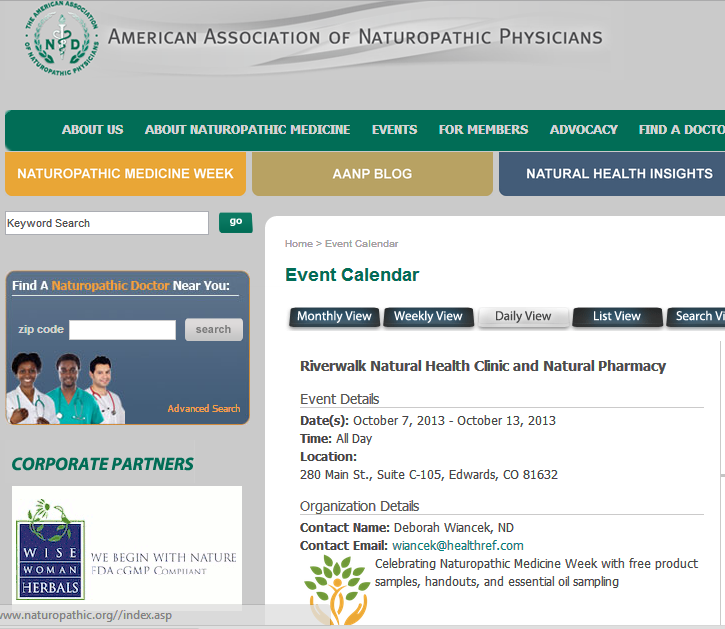
THIS WEEK ( Oct 7th-13th, 2013 ) 
Check out our featured event on
American Association of Naturopathic Physician (AANP) 's page!


Jun 6, 2013

Colorado Governor Signs Bill Regulating Naturopathic Doctors!


Colorado Governor Signs Bill Regulating Naturopathic Doctors 

Enactment Will Increase Access to Natural Medicine for Illness Prevention
Denver, CO, June 5 - Governor John Hickenlooper today signed into law a measure to allow naturopathic doctors to register with the state to legally practice naturopathic medicine. Colorado becomes the 17th state to do so, along with the District of Columbia.  
"I am proud that Colorado has taken the lead in ensuring that well trained naturopathic doctors, appropriately regulated, become a viable health care option for the citizens of our state," said Rep. Joann Ginal (D-Ft. Collins), the bill's lead sponsor. Sen. Linda Newell (D-Littleton), the bill's sponsor in the Senate, commented that "naturopathic doctors are going to be a key component in health care, saving the state millions of dollars through their focus on disease prevention and natural treatment, such as nutrition, lifestyle counseling and botanical medicine."
Naturopathic doctors are trained to prevent and treat chronic conditions associated with lifestyle - such as hypertension, weight gain, obesity, and diabetes - as well as most other illnesses. The law will enable Coloradans to distinguish between naturopathic doctors and lay or traditional naturopaths, who lack extensive graduate-level clinical training. The law allows naturopathic doctors who have completed a 4-year post-graduate program at an accredited naturopathic medical school and have passed a national science and clinical board exam to register with the state.
Currently, more than 150 naturopathic doctors practice in Colorado. As with other licensed medical professionals, a framework will now be provided for the safe and effective conduct of their profession, including:
  • A registration program for qualified naturopathic doctors
  • A multi-disciplinary advisory committee with oversight responsibility
  • Requirements to maintain liability insurance and meet continuing professional competencies
  • A requirement that naturopathic doctors communicate and collaborate, as appropriate, with other health care practitioners
"This is a great day for naturopathic doctors and the citizens of Colorado," remarked Denise Clark, ND, president of the Colorado Association of Naturopathic Doctors (CoAND). "Our members are dedicated to patient-centered, preventive care. Naturopathic doctors provide a safe, effective, and affordable alternative for patients seeking holistic health care."
"An increasing base of scientific research is affirming that naturopathic medicine is useful in the treatment of numerous chronic illnesses," observed Jud Richland, MPH, Chief Executive Officer of the American Association of Naturopathic Physicians (AANP). "A good example is the recent study in the Canadian Medical Association Journal, documenting that naturopathic medicine may reduce the risk of cardiovascular disease among people at high risk. Naturopathic medicine, with its emphasis on self-responsibility and body's inherent self-healing capacity, is effective in many cases of preventable illness, which affect a vast and increasing number of Americans."